A humanitarian protective presence brought around 35 Palestinians and Jews together in a West Bank village facing repeated violence — not simply to talk about peace, but to practice it.
There are moments when peacebuilding cannot remain inside conference rooms, dialogue circles, or international forums.
Sometimes, peace means showing up.
It means standing beside people when they feel vulnerable, listening to them when they feel forgotten, and turning years of dialogue into something tangible on the ground.
That was the purpose of our visit to Qusra, a Palestinian village south of Nablus that has faced repeated settler violence and growing pressure on its residents.
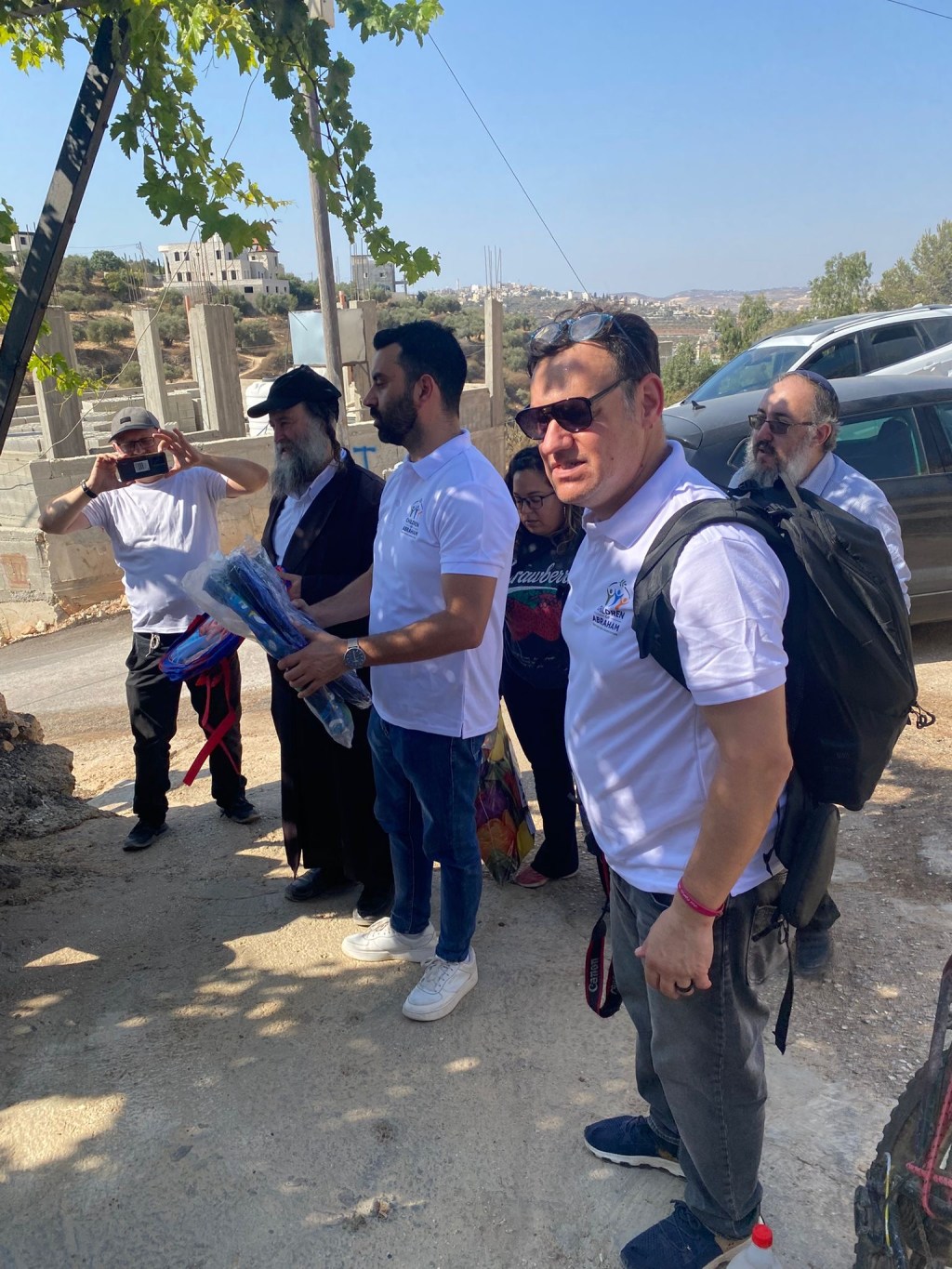
Through the Children of Abraham Project, we organized a humanitarian solidarity initiative and Protective Presence in the village, bringing together around 35 Palestinians and Jews — religious and secular — from the West Bank, Jerusalem, and Israel.
Children of Abraham is a U.S.-registered 501(c)(3) nonprofit organization founded by Jerry Katz. I lead its programs in Palestine and Israel, where much of our work focuses on building relationships across religious and national divides and translating those relationships into action.
Qusra was one of those moments.
We were not going there to pretend that Palestinians and Israelis experience this conflict in the same way.
We were going because civilians facing violence should not have to feel that they are standing alone.
Before We Even Reached the Village
At around 10:30 in the morning, our participants began traveling from different locations toward Qusra.
Before reaching the village, we encountered a scene that immediately reminded us why this initiative mattered.
Near Qusra, we saw a large group of extremist settlers — approximately 70 people — gathered near the road. Stones were being thrown and passing vehicles were being targeted.
We stopped our vehicles at the side of the road and waited.
Shortly afterward, Israeli police and military forces arrived and moved the group away, allowing us to continue.
We had not even entered Qusra yet, and already the abstract language of “violence,” “fear,” and “protective presence” had become very real.
Mahmoud Odeh: Choosing Peace After Loss
Our first stop was the home of Mahmoud Odeh, a Palestinian peace activist and a longtime participant and partner in peacebuilding initiatives.
For me, Mahmoud represents one of the most difficult and meaningful forms of peacebuilding: choosing dialogue not because you have escaped the pain of this conflict, but despite having experienced it personally.
Mahmoud’s younger brother, Muath Odeh, was killed during a settler attack on Qusra in October 2023.
According to Mahmoud and his family, a five-year-old girl had been wounded during the attack. Muath went to help provide first aid to her. While attempting to assist the wounded child, he was shot and killed.
The family continues to live with that loss.
They have also faced repeated attacks and damage to property, while the wider economic situation has left families in the area struggling with lost jobs, reduced income, and material losses for which meaningful compensation is often unavailable.
Yet when Mahmoud speaks about what happened to his brother, he does not speak about an entire people as his enemy.
He speaks about the need to continue building another future.
His grief has not disappeared. Neither has his anger or the pain of his family.
But he continues to believe that an extremist individual or group cannot be allowed to represent an entire religion or an entire people.
For Mahmoud, peace does not mean forgetting Muath.
It means trying to prevent another Palestinian or Israeli family from experiencing the same loss.
That distinction matters.
Why We Came to Qusra
After visiting Mahmoud and his family, we continued to the main municipal building, where representatives of the village welcomed our Palestinian and Jewish delegation.
As Executive Director and Holy Land Programs Director of the Children of Abraham Project, I opened our gathering by explaining why I believed our presence in Qusra was important.
We came to stand with Qusra.
And we should be willing to stand with every Palestinian village, community, and family facing violence, intimidation, or attacks.
But I also believe that standing against injustice and believing in Israeli-Palestinian peace are not contradictions.
In fact, one requires the other.
My own journey has taught me this.
As a young Palestinian during the Intifada, I once believed that throwing stones was a way to confront the reality around me.
Over the years, I came to understand that violence and revenge would not provide Palestinians with freedom, nor Israelis with security.
There had to be another path.
That realization led me toward dialogue, diplomacy, interfaith work, and peacebuilding — not because I stopped believing in Palestinian rights, but because I began believing more deeply that those rights must be achieved through a path capable of producing a future rather than another generation of graves.
I believe in a two-state solution based on justice, equality, freedom, dignity, and security for everyone.
For Palestinians, peace cannot mean accepting a life without freedom or dignity.
For Israelis, peace cannot mean living permanently in fear.
And for both peoples, revenge cannot become a vision for the future.
No extremist settler represents all Jews.
No extremist Palestinian group represents all Palestinians.
And no act of violence committed in the name of religion should be allowed to define an entire faith.
If we allow extremists to define one another for us, they will eventually define our future as well.
A School Bag Can Carry More Than Books
After our gathering at the municipality, we divided into groups and walked through parts of Qusra.
With the school year beginning, we distributed school bags, notebooks, and educational supplies to local children and families.
It was a simple humanitarian gesture.
But some of the most meaningful moments in peacebuilding are simple.
Palestinian families saw Palestinians and Jews arriving together, including visibly religious Jews, not to debate them and not to ask them to forget what they had experienced, but simply to stand beside them and offer something to their children.
The children responded with a mixture of curiosity, shyness, and happiness.
A backpack will not solve this conflict.
A notebook cannot reopen a blocked road.
A pencil cannot rebuild damaged property.
And none of them can bring Muath back to his family.
But they can carry a message:
We see you. We have not forgotten you. You are not alone.
The Homes We Could Not Reach
Our initiative was not intended to end with the distribution of school supplies.
An important part of the day was the Protective Presence itself.
We wanted to reach families living in some of the more isolated areas of Qusra and visit homes facing continued pressure.
Together, Palestinian and Jewish participants moved toward those homes.
But when we attempted to proceed, we found the main gate closed and were unable to reach the area as planned.
It was frustrating, but it also illustrated something important.
For many people watching this conflict from abroad, a closed gate may seem like a small detail.
For someone living behind it, it can determine whether you can reach your home, your land, your work, or another part of your own community.
We could not complete every part of the plan that day.
But we had come.
And sometimes presence itself is a beginning.
Peace Must Become a Verb
People often ask those of us involved in Israeli-Palestinian dialogue a fair question:
What does dialogue actually change?
My answer is that dialogue has little value if it ends when people leave the room.
The real test comes afterward.
Does the relationship survive disagreement?
Does it survive fear?
Does it survive war?
And when someone on the other side is suffering, are you willing to show up?
In Qusra, years of relationship-building became something physical.
Jewish participants, including religious Jews, traveled to a Palestinian village facing settler violence.
Palestinians welcomed them despite the fear and anger surrounding them.
A Palestinian peace activist who lost his brother continued to refuse collective hatred.
And people who carry profoundly different histories stood together in the same village and said that violence should not determine the future of either people.
This is what Protective Presence means to me.
It does not mean pretending there is no injustice.
It does not mean erasing differences in power or experience.
And peacebuilding should never require Palestinians or Israelis to erase their identity, history, pain, or legitimate rights.
It means refusing to abandon our humanity while confronting those realities.
It means standing against violence while refusing to become consumed by hatred.
It means demanding justice while still believing in a shared human future.
Around 35 Palestinians and Jews did not solve the Israeli-Palestinian conflict in Qusra that day.
We did something much smaller.
But perhaps something necessary.
We showed up for one another.
And during a time when Palestinians and Israelis are being told every day that the other side is nothing more than an enemy, sometimes simply showing up is an act of resistance against that idea.
Peace does not begin only when leaders sign an agreement.
Sometimes it begins on a blocked road.
Inside a grieving family’s home.
With a school bag in a child’s hands.
Or with Palestinians and Jews choosing, despite everything around them, to stand together.
Peace must be more than something we talk about.
It must be something we do.


